
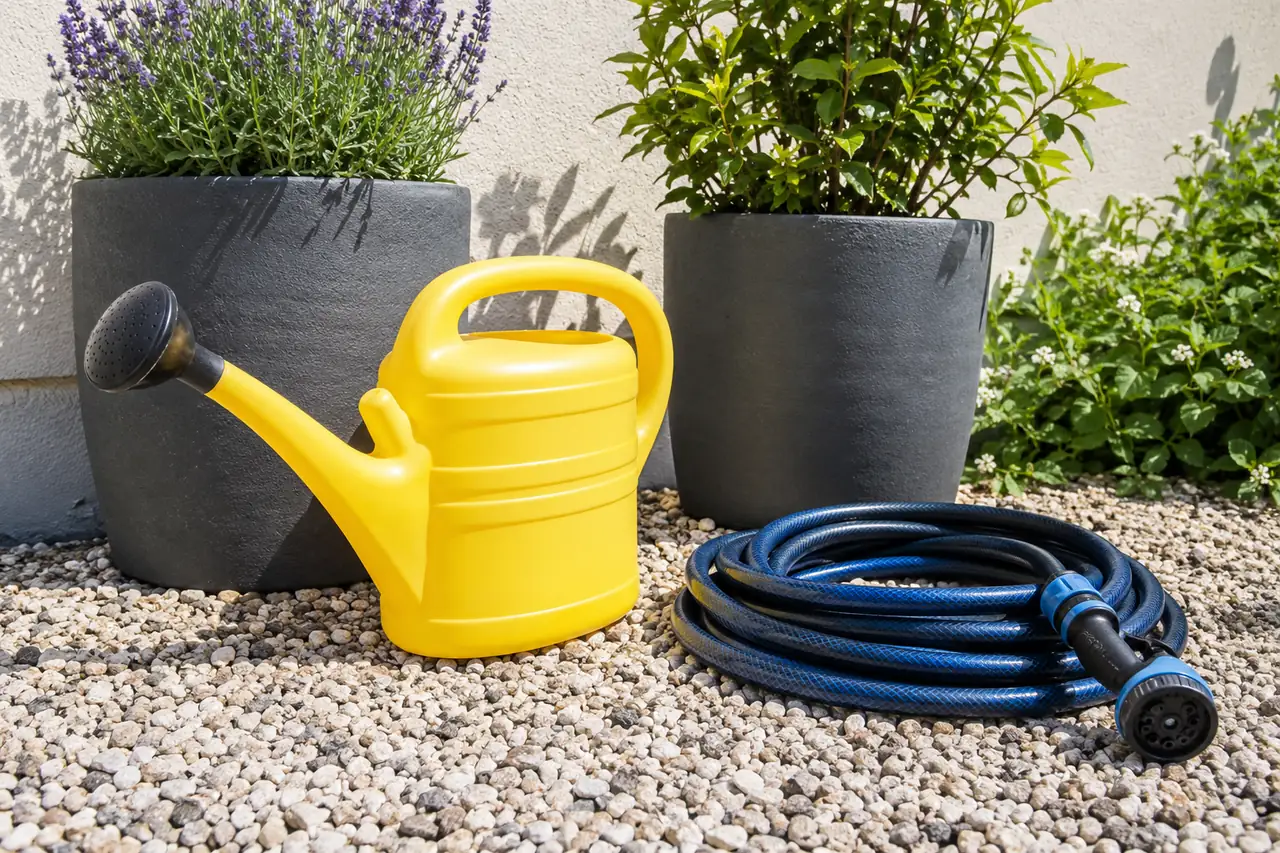
For a few pots close to the tap, start with a watering can you can carry and pour comfortably. Consider a hose when repeated carrying is the difficulty and you have a suitable tap, clear route and storage space.
Count the journeys as well as the containers. Four pots up steps can be more awkward to water than a larger group beside an outside tap. The useful purchase is the one that makes your real routine manageable while letting you control where the water goes.
Choose by the route from water to plant
| Your situation | Compare first | Main buying check |
|---|---|---|
| A few accessible pots near a tap or water butt | A watering can | Loaded weight and controlled pouring. |
| Many trips with a can, or carrying is difficult | A hose, if the tap and route suit it | Handling, fittings and safe storage. |
| A fixed group that needs watering during absences | A purpose-designed container irrigation system | Water source, compatibility and a trial before leaving. |
The RHS favours a can for precise container watering, while recognising that a hose can help when carrying or the area makes a can impractical. A hose still has to be pulled and put away, so check that work too.[1]
Choose a can by its loaded weight
A litre of water weighs about a kilogram. A five-litre fill therefore adds about 5kg before you count the can itself; ten litres adds about 10kg. Those are weight comparisons, not recommended amounts for your plants. You can partly fill a larger can, but its empty body and length still need to suit you.[2]
Compare the handle opening, grip and balance while tipping. Can you support the front comfortably with your other hand? Can you pour into a pot without reaching awkwardly? If you wear gardening gloves, include them in a permitted shop handling check. An empty can alone will not establish how it feels when loaded.
Measure beneath the tap where you will fill it, especially a low water-butt tap. Check the filling opening and handle clearance. A can that fits on the shelf may not fit under your usual water source.
Check the spout and rose
A direct spout is useful for placing water on the compost between established plants. A rose spreads the stream into droplets; a fine rose is useful for seeds and seedlings that a concentrated stream could disturb. Choose according to the tasks you actually have.[2]
For crowded pots, check whether the spout can reach the compost without catching foliage. A longer spout may help, but also needs more storage space. Ask whether the rose comes off easily and whether it is included in the price.
Look up a replacement rose before buying. Fit is not universal: Haws, for example, specifies compatible ferrules for its different cans. A generic replacement that looks similar may not fit your model. Keep the model name or photograph the label.[3]
Plastic keeps the empty can lighter; metal generally adds weight. Compare construction and care guidance rather than choosing solely by finish. If liquid feed is one of your uses, check the can and feed instructions for compatibility. There is no need to replace a sound can that already pours well.[2]
Buy the hose length your route requires
Measure the route around corners and obstacles, not a straight line from tap to furthest pot. A length of string can help. Allow enough slack for comfortable movement, then compare the shortest available length that works. Extra hose means extra material to pull, coil and store.
Confirm your tap type and the hose’s fittings before paying. Read the contents list for a tap connector, any adapter, both hose-end fittings and a suitable nozzle. A bundle described as a “set” may include different parts from another set.
GARDENA’s Basic 20m set, for example, lists its fittings and supported tap-thread sizes. Look for that detail when comparing sets. This is a documentation example, not a product recommendation.[4]
Before connecting a hose or mains-fed irrigation, check the required backflow protection with your water supplier or a qualified installer. A tap adapter or nozzle is not a substitute for suitable protection. Keep the hose end out of ponds, drains and standing water in buckets or cans. Permanent irrigation may need additional safeguards.[1][8]
If a hose uses an indoor tap, check the exact tap adapter and its instructions. Plan a route that keeps doors, steps and access usable. Include where water could drip during disconnection, and avoid routing a hose where it must be trapped by a closing door.
Check handling and storage before extras
Compare the effort of carrying a coil, unwinding it and using a reel. A large wall-mounted reel is an unnecessary extra if a manageable short hose and simple storage meet your needs. If wall fixing is proposed, check the position, suitable fixings and any landlord or building requirements.
For an expanding hose, read the operating conditions carefully. Hozelock says its Superhoze’s maximum length depends on pressure, and it must be fully unwound to expand. Check the equivalent instructions for the model you are considering, including draining and cold-weather storage.[5]
Choose a nozzle with a flow you can control gently and a stop control you can use easily. The RHS advises slow watering close to the compost. A powerful jet or numerous spray patterns are not useful purchase priorities for a few ordinary patio pots.[7]
Three practical buying decisions
Four balcony pots and no outside tap. Compare a modest can that fits under the filling tap and through the balcony door. A three-litre model is one size to examine, not a prescribed choice. Check its loaded weight and spout reach before buying a hose with an indoor adapter.
A larger patio group beside an outside tap. If carrying has become tiresome, compare a hose matched to the measured route with straightforward storage and a controllable nozzle. Keep a usable can for small jobs or stored rainwater rather than treating the hose as a complete replacement.
Pots that need care while you are away. A bigger can does not solve the absence. Consider a person who can water them or a compatible irrigation setup. Run any new system while you are home and inspect each pot. A timer setting needs to suit the actual plants and conditions.
Check local restrictions and the complete cost
Before using a hose or irrigation system, check your water company’s current restrictions and any relevant exemptions. Water UK says cans are generally allowed during temporary-use bans, but the supplier’s specific rules matter. Do not assume that a timer or a different hose type changes the rules.[6]
Compare the total including adapters, nozzle, reel or storage, delivery and replacement parts. Start with the useful control and manageable handling. Keep watering decisions tied to the plants and compost; the peat-free guide explains why surface appearance alone can mislead, and the drainage guide helps with a pot that stays wet.
- Measure the route and filling space.
- Compare loaded weight or hose handling.
- Confirm the spout or nozzle suits your plants.
- Check included parts, compatibility and spares.
- Plan storage and compare the complete cost.
How this guide was prepared
This is an editorial buying guide based on published horticultural guidance and manufacturer information. HandyGarden has not physically tested products for this article. The examples are illustrative, and no affiliate links are included.
Sources
- RHS Advice Team: Garden watering methods.
- Haws UK: Choosing the Right Can.
- Haws UK: Rose compatibility.
- GARDENA UK: Basic Hose Set 13 mm 20 m, article 18970-28.
- Hozelock: Superhoze Hints and Tips.
- Water UK: Hosepipe bans FAQs.
- RHS Advice Team: How to water containers.
- Water Regs UK: Looking after water.
Sources checked 7 October 2026. Check current product specifications, care instructions and seller terms before buying.
Leave a Reply