
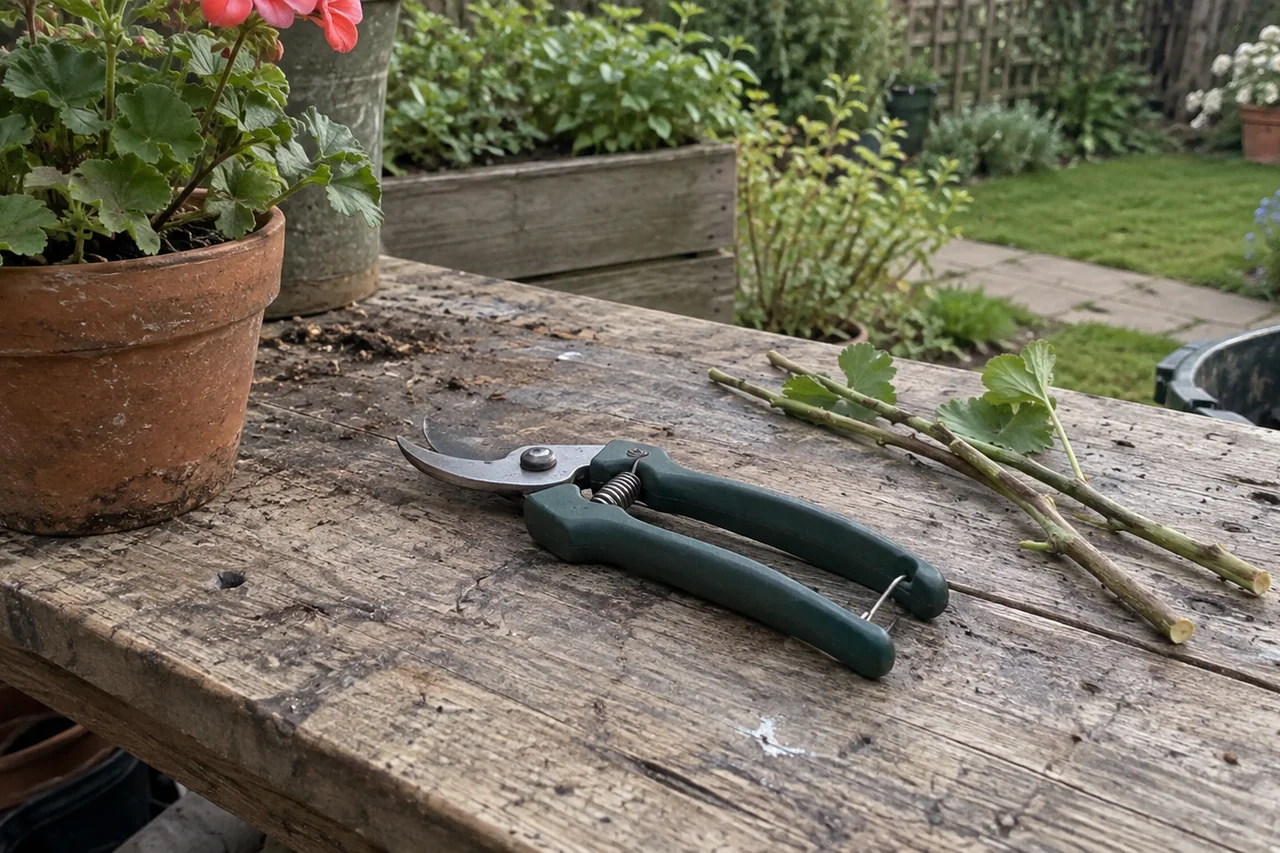
For routine pruning of living stems, begin by comparing bypass secateurs that fit your hand. Choose anvil secateurs for a clear dead-wood job, and use a suitable larger tool when a stem exceeds a secateur’s capacity.
A small garden does not automatically need tiny secateurs or a complete pruning set. Write down the cuts you expect to make: deadheading flowers, trimming a shrub, or dealing with dead twigs. That list is more useful than a “professional” label or the largest cutting diameter on the shelf.
Bypass or anvil
| Type | How it cuts | Where to start |
|---|---|---|
| Bypass | The cutting blade passes a counterblade. | Live stems and ordinary plant pruning. |
| Anvil | The blade closes onto a supporting plate. | Dead wood within the model’s stated limit. |
GARDENA explains that anvil action can bruise living plant tissue, while bypass action is suited to it. For one first pair used on live plants, bypass is the practical starting point. Neither design makes an over-thick branch an appropriate cut.[1]
A ratchet, geared mechanism or rotating handle is an additional design feature to assess. Read what it does on that particular model, which cutting action it uses and how you operate it. Do not buy a mechanism solely because the listing promises less effort; check whether it suits your hand and normal tasks.
Put hand fit ahead of maximum capacity
The handles need to open far enough for the work while remaining within a comfortable reach. If you can only catch them with your fingertips, a large model may be a poor choice. Check any adjustable opening and the maker’s hand-size guide rather than assuming a “small” or “medium” label is standard across brands.
Ask to handle a display pair safely in a shop. Open and close it without placing fingers near the cutting head. Check the grip, spring return and catch, including with gloves if that is how you garden. Your hand should not have to slide into an awkward position to reach the catch.
Check whether the model is intended for your cutting hand. Some tools are described as suitable for either hand; others have a dedicated left- or right-handed design. Confirm the actual model rather than relying on the shape in a photograph. Chris Heavey’s horticultural teaching article also highlights handedness when choosing secateurs.[2]
If shopping online, use the size chart and read the seller’s returns conditions before ordering. A product description cannot settle personal fit, and an unused handling check is different from pruning with it. Confirm what condition the seller requires for a return.
Read the specification without treating it as a test
Manufacturer information can help eliminate unsuitable options. For example, FELCO lists model 6 as a medium-hand, right-handed bypass tool with a 20mm cutting diameter. Its model 16 is listed for medium left hands, also with a 20mm diameter. These are documented specifications, not HandyGarden test results or a recommendation to buy either.[3][4]
Treat the stated diameter as a limit to respect, not a target for every cut. Check the intended material and instructions. Two models with the same number can differ in fit and controls, and the specification does not show how much effort you will find comfortable.
If a cut needs force that you cannot apply comfortably, stop rather than twisting the tool or forcing the handles. For larger work, identify whether loppers or a pruning saw are appropriate. Heavey describes these as different tools for different parts of a pruning job; one pair of secateurs is not a substitute for all three.[2]
Look up the parts before buying the tool
Find the model number and search the maker’s current parts list. Can you identify a replacement blade, spring and catch for that exact pair? Check whether the instructions explain adjustment, sharpening and replacement, and whether a supplier serving the UK actually offers the parts you are likely to need.
Do not assume a blade that looks similar will fit. If the model is discontinued, ask about compatible parts before choosing a clearance offer. For a tool you expect to use frequently, an understandable repair route is a useful reason to pay more.
Read the warranty scope as carefully as its headline. FELCO’s model 6 page, for example, limits its lifetime warranty to forged aluminium handles and excludes components such as blades and springs. That distinction matters when comparing a repairable tool’s possible future costs.[3]
Check whether your existing pair needs care
A sticky pair may need maintenance rather than replacement. The RHS explains that dried sap attracts grime and can make pruning blades stick. Follow the tool’s instructions for cleaning, adjustment and lubrication, and keep it dry in storage. Check the RHS cleaning guide for tools used on diseased plant material.[5]
Inspect for visible damage, loose parts and poor blade alignment without putting fingers in the cutting path. If a blade or locking mechanism is damaged, obtain the correct repair or replace the tool. A new spring is only worthwhile if the rest of the pair is sound.
Include the storage place in the decision. A small dry box or suitable holder may be enough. There is little value in buying an elaborate kit if the cutting tool will still be left damp outside.
Three ways to avoid buying too much
Mostly herbs and flowers. Start with the cutting jobs you actually do. A suitable clean pair of scissors may handle soft herb harvesting, while bypass secateurs suit the woody stems you also need to prune. You do not need an anvil pair just because it comes in a discounted set. See choosing a useful herb group for the planting context.
A few shrubs and a rose. Prioritise comfortable bypass secateurs, a catch you can use and a realistic parts route. Add another cutting tool only when a specific job requires it. More cutting capacity on paper is a weak reason to accept handles that are too wide for your hand.
Regular dead-wood clearing. An anvil pair may earn its place for smaller suitable pieces, but sort the thicker material first. If the actual work needs loppers or a saw, buying stronger-looking secateurs can leave the main job unsolved.
Before paying
- Identify the live or dead stems and the appropriate tool.
- Check fit, handedness, spring return and locking catch.
- Read the model’s capacity and intended use.
- Confirm exact replacement parts, care instructions and warranty scope.
- Compare the tool, necessary upkeep and delivery as one purchase.
Choose the simplest suitable tool within your budget. Buying it does not establish when a plant should be pruned: check plant-specific guidance before cutting. For potted herbs, the winter-care guide explains why the plant’s identity and conditions still matter.
How this guide was prepared
This is an editorial buying guide based on published horticultural guidance and manufacturer information. HandyGarden has not physically tested products for this article. The examples are illustrative, and no affiliate links are included.
Sources
- GARDENA UK: Difference between bypass and anvil secateurs.
- Chris Heavey: Garden tools think before you buy.
- FELCO EU: FELCO 6 manufacturer specification.
- FELCO EU: FELCO 16 manufacturer specification.
- RHS Advice Team: Cleaning hand tools.
Sources checked 7 October 2026. Check current product specifications, care instructions and seller terms before buying.
Leave a Reply