
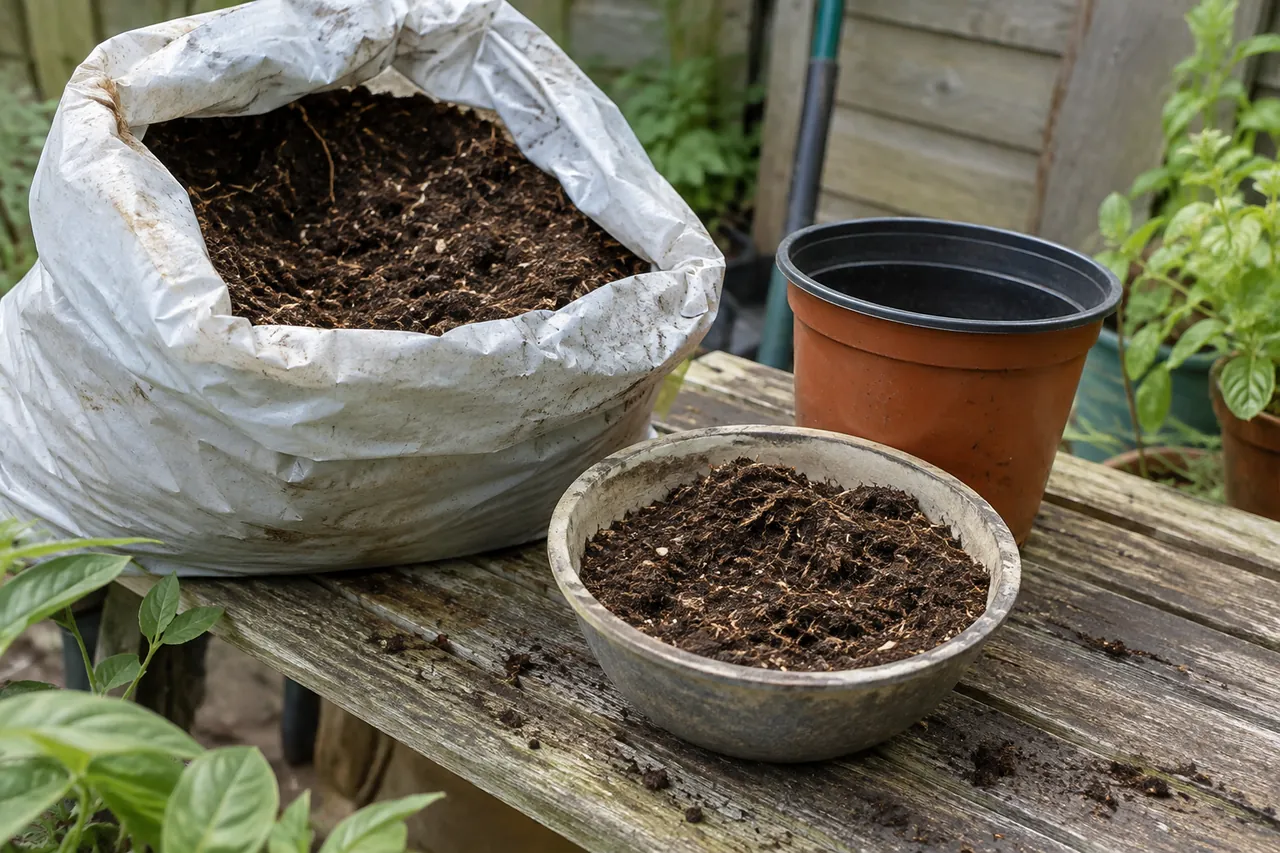
Choose peat-free compost for the job: seed sowing, seasonal containers, long-term shrubs or acid-loving plants. Check its included feed and the moisture below the surface before adding water or fertiliser.
Two bags can both say “peat-free” and do different jobs. One may be a fine seed mix; another is made for a shrub that will stay in its pot for years. Write down what you are planting before comparing the bags.
Match the mix to the planting
| Your job | What to look for |
|---|---|
| Sowing seeds or rooting cuttings | A peat-free seed or cutting mix recommended for the task. |
| A seasonal flower display or many vegetable crops | A peat-free multi-purpose or container mix; check the plant’s requirements. |
| A shrub staying in its pot | A peat-free, soil-based mix intended for long-term containers. |
| An acid-loving plant such as a blueberry | A suitable peat-free ericaceous mix. |
The RHS distinguishes these uses. Homemade garden compost is useful in the garden, but it is not a bagged growing medium with the same formulation. Do not fill a seed tray with it simply because both materials are called compost.
Before buying a bag
Look for an explicit peat-free statement. “Organic” and “environmentally friendly” do not tell you whether peat is present. Read the recommended uses, any added fertiliser and the storage instructions. If there is a production date, check it.
Work out how much you will use for the planned pots. Buying a large stock for several future seasons ties you to material that deteriorates in storage. A specialist bag shared with another gardener may be more useful than a half-used one left outside.
Read one real product’s instructions
Melcourt’s published instructions for SylvaGrow Multi-Purpose show why the small print matters. This is an example of reading a product’s purpose and care instructions, not a comparison of how different brands perform.[3]
| Detail to read | What it means for your plan |
|---|---|
| Purpose | The manufacturer lists potting-on and container uses, but says this mix is unsuitable for acid-loving plants in containers. A blueberry needs an ericaceous option. |
| Included nutrients | The manufacturer states that the included nutrients cover the first four to six weeks of growth. Read the later feeding instructions alongside the plant’s needs and season; this is not a winter feeding timetable. |
| Pack volume | The product is listed in 15-litre and 40-litre bags. Work out the planned fill volume before choosing a size. |
| Freshness and storage | Melcourt advises use within the season of purchase, preferably within a year of manufacture. Close the bag after use and store it in cool, dry conditions. |
Check the instructions on the bag you actually buy, including its safety advice. Another product with a similar name may have different ingredients, feed or uses; the word “peat-free” does not make the rest interchangeable.
How much compost will you need?
Use internal dimensions and the depth you intend to fill, rather than the outside height of the pot. For a straight-sided rectangular container, multiply length × width × fill depth in centimetres, then divide by 1,000 for litres.
For example, a container measuring 30cm × 30cm inside, filled to a depth of 25cm, holds 30 × 30 × 25 ÷ 1,000 = 22.5 litres. That fill depth already leaves a 5cm watering gap in a 30cm-deep container. If three rootballs occupy about 1 litre each, about 19.5 litres of new mix is needed around them.
This is an estimate: tapered pots, irregular rootballs and settling change the amount. For a shaped pot, use the maker’s capacity as a guide and still allow for the watering gap and rootballs. Choose the container to suit the planting; the first-container plan explains that decision.
Learn how this mix holds water
A dry-looking surface can hide damp compost below. Feel into the mix before watering, and use the weight of a small pot as another clue. Add water gradually when it is needed. The mix should serve the plant’s roots, not a fixed daily watering habit. If it stays sodden, check the holes, outer pot and drainage route before changing products.
Follow the bag and feed instructions rather than assuming the fertiliser in the compost will last for a whole season. Note the product name and how it behaves in your pots. That gives you something concrete to compare next time.
Do not add water or feed just because it is peat-free
RHS trials at four UK nurseries ran over 18 months using normal irrigation. Five of six peat-free mixes had similar or higher average moisture than the peat-reduced controls, and all produced saleable plants.[1] The trials covered different crops, pot sizes and watering systems, so they do not give a timetable for your patio. They do give a reason to check below the dry-looking surface before watering again.
A separate RHS report describes three years of trials at two nurseries. Extra fertiliser did not bring a matching improvement, and too much could hinder root and shoot establishment.[2] These are commercial trial reports, not a universal home dosage. Read what feed is already in your bag and follow the plant and fertiliser instructions; do not automatically add more.
Dr Prasad puts the link plainly: “Water management and nutrition management are two sides of the same coin.”[2] The report explains that overwatering washes nutrients out faster. Checking moisture helps you avoid both unnecessary watering and the temptation to replace lost feed automatically.
Start with a useful comparison
If you compare two mixes, keep the plant, pot size and position as similar as possible, and record watering and any feed. This is a useful home comparison, not a controlled product trial. A different result on a windy doorstep does not establish which bag is better.
Sources for these details
- Olivia Drake; trials led by Dr Raghavendra Prasad, RHS Science reveals peat-free doesn’t need additional water, Royal Horticultural Society, 2024. Read the source.
- Olivia Drake; trials led by Dr Raghavendra Prasad, Are you overfeeding your peat-free plants?, Royal Horticultural Society, 2025. Read the source.
- Melcourt, SylvaGrow Multi-Purpose, manufacturer’s product and use instructions, checked 7 October 2026. Read the instructions.