
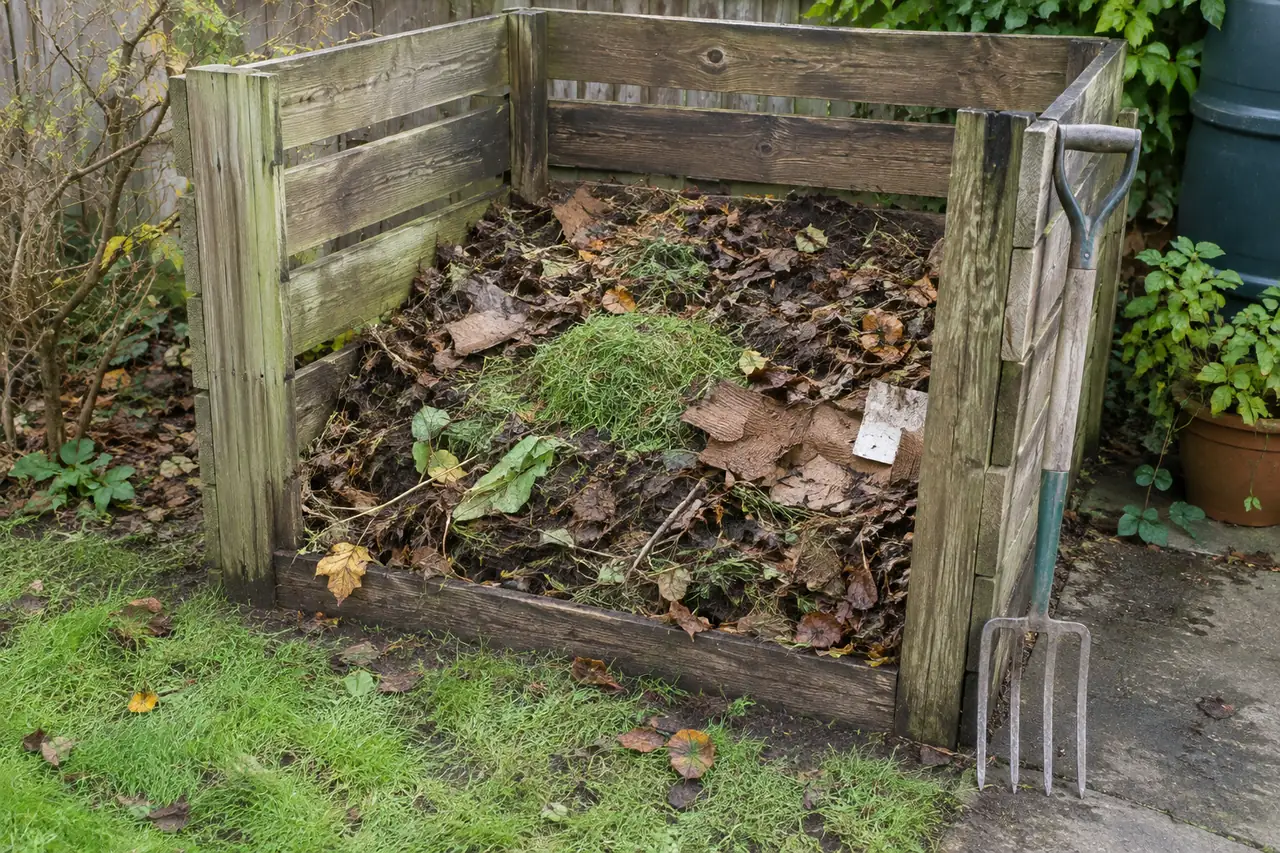
For wet, smelly compost, check compacted layers, too many greens and trapped rain before adding anything. Dry material needs a different correction, and a cool small bin is not automatically a failed one.
Lift the lid and look below the fresh scraps. Is the older material soggy, dry or simply still recognisable? Those are different problems. This guide covers a garden bin or heap; a kitchen caddy, wormery or electric food recycler needs different advice.
Find the closest match
| What you notice | What to try | At the next check |
|---|---|---|
| A sharp ammonia smell | Check for an excess of greens, such as a thick layer of grass. Mix in suitable dry browns and loosen the mass. | Has the sharp smell eased, and is the layer less compacted? |
| A rotten-egg smell, often with wet, compacted material | Break up matted layers, introduce air and add dry browns where needed. Keep excess rain out and check liquid can drain. | Is the same layer looser and less sodden, with a less offensive smell? |
| Dry stems and paper with little change | Dampen and mix the contents. Add soft green material to a heap dominated by dry woody ingredients. | Is the older material damp through and starting to soften? |
| A mass of grass clippings | Break it up and mix in torn cardboard or chopped woody material. Spread future additions through the mixture. | Can you loosen the mixture without finding another solid wet mat? |
| A cool heap that changes slowly | Small, gradually filled bins may never become hot. Give the batch time; check moisture and the mix before calling it a failure. | Over time, are the older ingredients becoming less recognisable? |
Cathy Cromell distinguishes ammonia, usually linked to excess greens, from rotten-egg smells linked to poor aeration or excess moisture.[1] Treat the smell as a clue and inspect the mix. Make one correction you can observe, rather than adding water and an activator together.
Mix what is already there
For a manageable heap, emptying and refilling gives you a chance to break up dense layers. If that is impractical, stir accessible contents with a fork. Do not force a heavy lift just to copy a full-size compost bay.
Garden Organic describes a cool system that you fill gradually, then leave to finish. Keep putting fresh peelings into the same batch and you will keep finding fresh peelings. Choose a stopping point and arrange somewhere for the next kitchen scraps to go.
If you need a workable place for those new scraps, compare small-garden composting systems. The next batch does not have to go into a second purchased bin.
Why a cool bin can still be working
A small bin can also be active without feeling hot. A Wisconsin study compared three very different compost systems. Its household banana-and-leaf bin had a highest recorded temperature of 32°C, yet its microbial community changed during the six-week sampling period.[2] This does not prove that a cool batch is finished, or that it has killed weed seeds and pathogens. Check moisture and the older material before deciding it has failed.
Slow is different from unfinished
Large twigs do not disappear as quickly as soft scraps. When much of the batch has become dark, earthy-smelling material, separate out large unfinished pieces for the next batch. Check the older contents rather than judging everything by the top layer you added yesterday.
Garden Organic recommends leaving dark-brown, earthy-smelling compost for another month or two to mature before using it. Some small twigs or eggshell pieces can remain. Recognisable fresh scraps or a sour, sodden layer still need time and attention; the calendar alone does not make them ready.
When the problem needs a different check
A rat sighting calls for a closer look at the site and ingredients; an activator will not solve it. Keep unsuitable food out and seek local pest advice if there is continuing activity. Insects and other small creatures in a garden heap are not, on their own, evidence that the compost has failed.
If clouds of flies appear when you open the bin, cover exposed kitchen scraps with garden waste and check for excessive dampness or poor aeration. This is the RHS’s practical advice for a swarm, rather than a reason to remove every ordinary decomposer insect.
Put a dated note on the bin after changing the mix. At the next check, compare the same part of the heap. You want to know whether the wet layer has loosened or the dry material has begun to soften.
Sources for these details
- Cathy Cromell and the Editors of the National Gardening Association, Composting For Dummies, Wiley Publishing, 2010, pp. 189, 191–192.
- T.C. Weglarz, L.K. Holsen, R.R. Ribbons and D.J. Hall, “Microbial diversity and nitrogen-metabolizing gene abundance in backyard food waste composting systems”, Journal of Applied Microbiology, 2018, 125(4), 1066–1075. Read the source.