
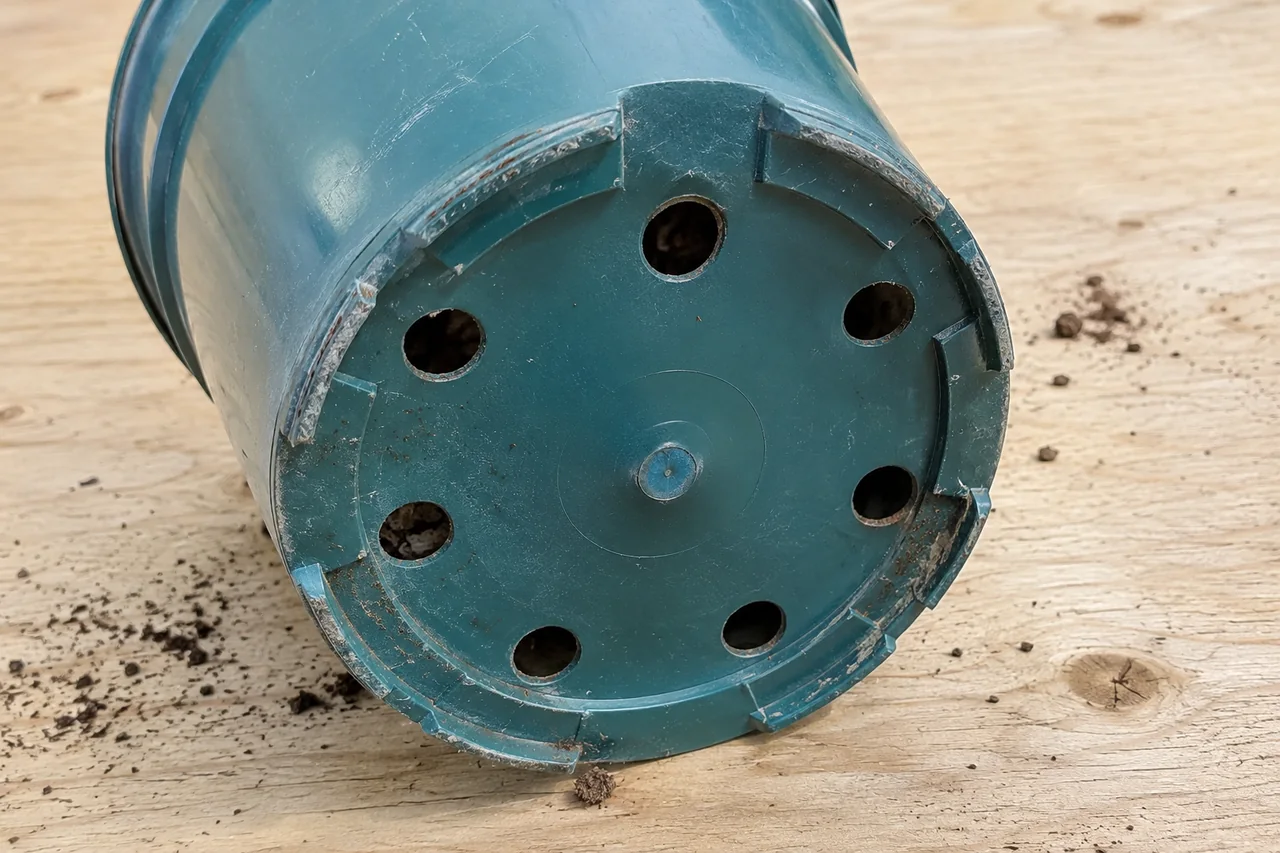
Start with open drainage holes and remove water trapped in a saucer or cover pot. Gravel cannot fix a sealed base; choose a suitable growing mix and check moisture before watering again.
If a pot stays sodden, start at its base. Water needs somewhere to leave. A decorative planter with no outlet is a cover pot, not a drainage solution; a nursery pot inside it can still end up sitting in collected water.
Follow the water’s route
- Check whether the planted container has open drainage holes. Look underneath, rather than assuming they are there.
- Empty water held in an outer pot or saucer. For ordinary outdoor plants, remove standing-water trays over winter.
- Check whether the base is pressed against paving. Stable pot feet can keep the outlet clear.
- If the holes are open but the mix stays dense and wet, assess the growing mix and whether the plant is in an overly large pot.
Use support that keeps the pot steady. Raising a tall container on a narrow stack of bricks creates a new problem. Do not tip a heavy planted pot on your own just to see underneath.
Should you add a bottom layer?
A single crock over one large hole can stop compost falling out. That is different from filling the bottom of the pot with rubble. Small drainage holes usually need no covering.
For this purpose, the RHS planting guide calls a hole large when it is more than about 2.5cm across. Cover it without sealing the outlet; the aim is to retain compost while water can still escape.
The RHS advises against adding crocks to improve drainage. Research makes the broader claim that every coarse layer worsens drainage less certain.
What the 2025 study measured
Avery Rowe’s 2025 experiment used three mixes in 1.29-litre pots, with gravel, LECA, grit or sand in 3cm or 6cm layers, generally ten pots per treatment. After saturation and free drainage, layers often reduced water retention in the loamless mixes; most John Innes treatments were unchanged. No living plants were tested.[1]
For an ordinary patio pot, we would start with open outlets, a growing mix suited to the plant and enough compost for its roots. The study does not show that adding gravel will make your plant healthier. A bottom layer also takes up growing space and cannot rescue a sealed base or a full saucer.
Check before watering a wilting plant
Wilting is a reason to inspect, not proof that a pot is dry. Feel below the surface. If the mix is already wet, another watering will not correct blocked drainage. Where the plant continues to decline, check its identity and root condition before deciding on repotting or disease treatment.
RHS maintenance advice notes that old compost can lose its structure and become dense. If repotting is needed, use a suitable fresh mix and a pot appropriate to the rootball, with an outlet that remains open.
After the next spell of rain
After heavy rain, look for water trapped in the outer pot and feel below the compost surface. For the wider winter check, see protecting pots and their plants. Plants deliberately grown in wet conditions need their own care instructions.
Sources for these details
- Avery Rowe, “Effect of drainage layers on water retention of potting media in containers”, PLOS ONE, 2025, 20(2), e0318716. Read the source.